

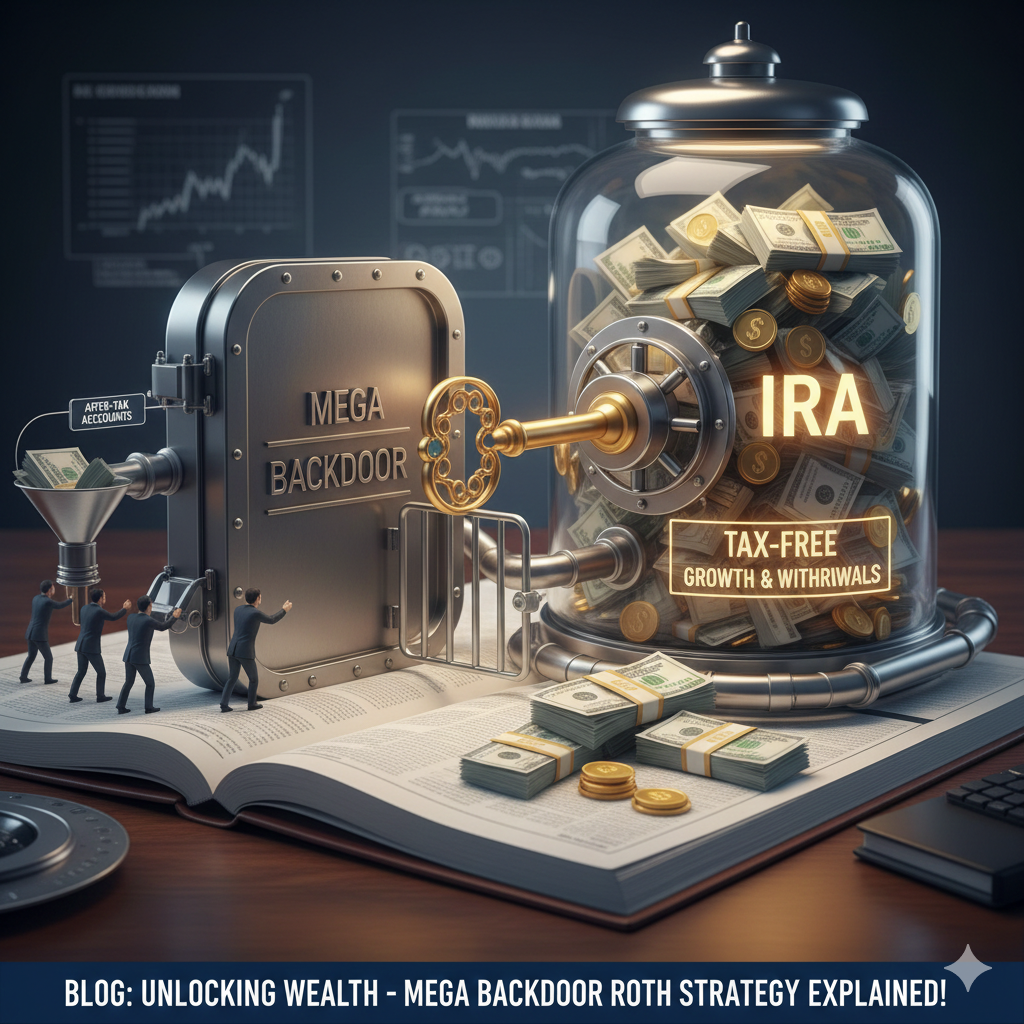
The MEGA Backdoor Roth: A Powerful Wealth-Building Strategy Hiding in Your 401(k)
If you’re already maxing out your traditional 401(k) contributions and looking for additional ways to grow tax-free retirement savings, the Mega Backdoor Roth strategy might be one of the most powerful—and underutilized—tools available to you. This strategy allows eligible participants to contribute significantly more to their retirement accounts on an after-tax basis and then convert those dollars into a Roth account, where they can grow and eventually be withdrawn completely tax-free.
What Is a Mega Backdoor Roth?
Most people are familiar with the annual 401(k) employee deferral limit—$24,500 in 2026 (or $32,500 if you’re age 50 or older). However, what many don’t realize is that the overall annual limit on total contributions to a 401(k) plan—including employee deferrals, employer matching contributions, and after-tax contributions—is significantly higher. In 2026, that combined limit is $72,000 (or $80,000 for those 50 and older).
The Mega Backdoor Roth strategy takes advantage of the gap between what you can defer as an employee and that overall plan limit. Here’s how it works: after you’ve maxed out your pre-tax or Roth 401(k) deferrals and your employer has made its matching contributions, the remaining room up to the $70,000 total limit can potentially be filled with after-tax contributions—and then converted to a Roth account.
The Key Requirement: Your Plan Must Allow After-Tax Contributions
This is the critical point that determines whether you can use this strategy: your employer’s 401(k) plan must specifically permit after-tax contributions. Not all plans do. After-tax contributions are a distinct contribution type—separate from both pre-tax deferrals and designated Roth deferrals. They go into the plan on an after-tax basis (meaning you’ve already paid income tax on the money), but unlike Roth contributions, the earnings on after-tax contributions grow tax-deferred and would be taxed as ordinary income upon withdrawal if left in the after-tax account. That’s why the conversion step is so important—it moves both the contributions and any earnings into a Roth environment where future growth is tax-free.
It’s worth noting that after-tax contribution provisions are more commonly found in 401(k) plans offered by larger companies. Larger employers tend to have more robust plan designs, more administrative resources, and greater flexibility to include features like after-tax contributions and in-plan Roth conversions. If you work for a mid-size or smaller employer, your plan may not offer this option—but it’s always worth checking with your HR department or plan administrator.
How the Conversion Works
Once after-tax contributions are made to your 401(k), the next step is converting them to Roth. There are generally two ways this happens:
- In-Plan Roth Conversion: Your after-tax contributions are converted directly into the designated Roth account within your 401(k) plan. This keeps everything under one roof and is generally the simplest approach.
- In-Service Rollover to a Roth IRA: Some plans allow you to roll your after-tax contributions out of the 401(k) and into an external Roth IRA while you’re still employed. This can give you broader investment options and more flexibility.
In either case, the sooner you convert after making the after-tax contribution, the better. Converting quickly minimizes the earnings that accumulate in the after-tax account. Since the contribution itself has already been taxed, only the earnings are subject to income tax upon conversion. The less time earnings have to build up before conversion, the smaller the potential tax bill.
The Game-Changer: Automatic Roth Conversions
Here’s where the strategy becomes truly seamless. Depending on your 401(k) plan provider, your plan may offer an automatic conversion feature that immediately converts every after-tax contribution into your Roth account as soon as it hits the plan. This is sometimes referred to as an “auto-sweep” or “auto-convert” feature.
When automatic conversion is available, you don’t have to remember to manually initiate a conversion each pay period or worry about earnings accumulating in the after-tax account. The dollars go in after-tax and are immediately moved to Roth—creating a virtually frictionless Mega Backdoor Roth experience. Because the conversion happens almost instantaneously, there are typically little to no earnings to be taxed at the time of conversion, making this approach incredibly tax-efficient.
Not all providers offer this feature, so if you’re considering the Mega Backdoor Roth strategy, it’s important to ask your plan administrator or provider whether automatic in-plan Roth conversions are available.
A Quick Example
Let’s say you’re 45 years old, earning $200,000, and your employer matches 50% of the first 6% you contribute. Here’s how the math might look in 2026:
- Your pre-tax/Roth 401(k) deferral: $24,500
- Employer match (50% of 6% of $200,000): $6,000
- Total so far: $30,500
- Remaining room up to $72,000 limit: $41,500
- Potential after-tax contribution (converted to Roth): Up to $41,500
That’s an additional $41,500 that can be funneled into a Roth account each year—money that will grow tax-free and can be withdrawn tax-free in retirement. Over a career, the compounding effect of these additional Roth dollars can be substantial.
Who Should Consider This Strategy?
The Mega Backdoor Roth is especially attractive for high-income earners who are already maxing out their standard 401(k) deferrals and want to build additional tax-free retirement savings. It’s also particularly valuable for individuals who are phased out of making direct Roth IRA contributions due to income limits—the Mega Backdoor Roth has no income restriction as long as your plan supports the necessary features.
This strategy can also be beneficial for younger workers with a long time horizon, as the tax-free growth period in the Roth account is maximized. And for those thinking about estate planning, Roth assets pass to heirs with no income tax burden, making them among the most efficient assets to leave behind.
Important Considerations
While the Mega Backdoor Roth is a powerful strategy, there are a few things to keep in mind. First, you’ll need adequate cash flow to fund these additional after-tax contributions on top of your regular deferrals. Second, your plan’s specific rules around after-tax contributions and conversions will dictate exactly how and when you can execute the strategy. Third, non-discrimination testing requirements may limit how much highly compensated employees can contribute in after-tax dollars, depending on your plan’s participation rates. Finally, tax rules and plan provisions can change, so it’s important to stay informed and work with a knowledgeable advisor.
The Bottom Line
The Mega Backdoor Roth is one of the most effective strategies available for building tax-free wealth through your employer-sponsored retirement plan. If your 401(k) allows after-tax contributions and offers in-plan Roth conversions—especially with an automatic conversion feature—you could be adding tens of thousands of additional dollars to your Roth bucket each year.
Not sure if your plan qualifies? We can help you review your plan’s features and determine whether this strategy makes sense for your overall financial picture. Contact Forty W Advisors to schedule a conversation.