

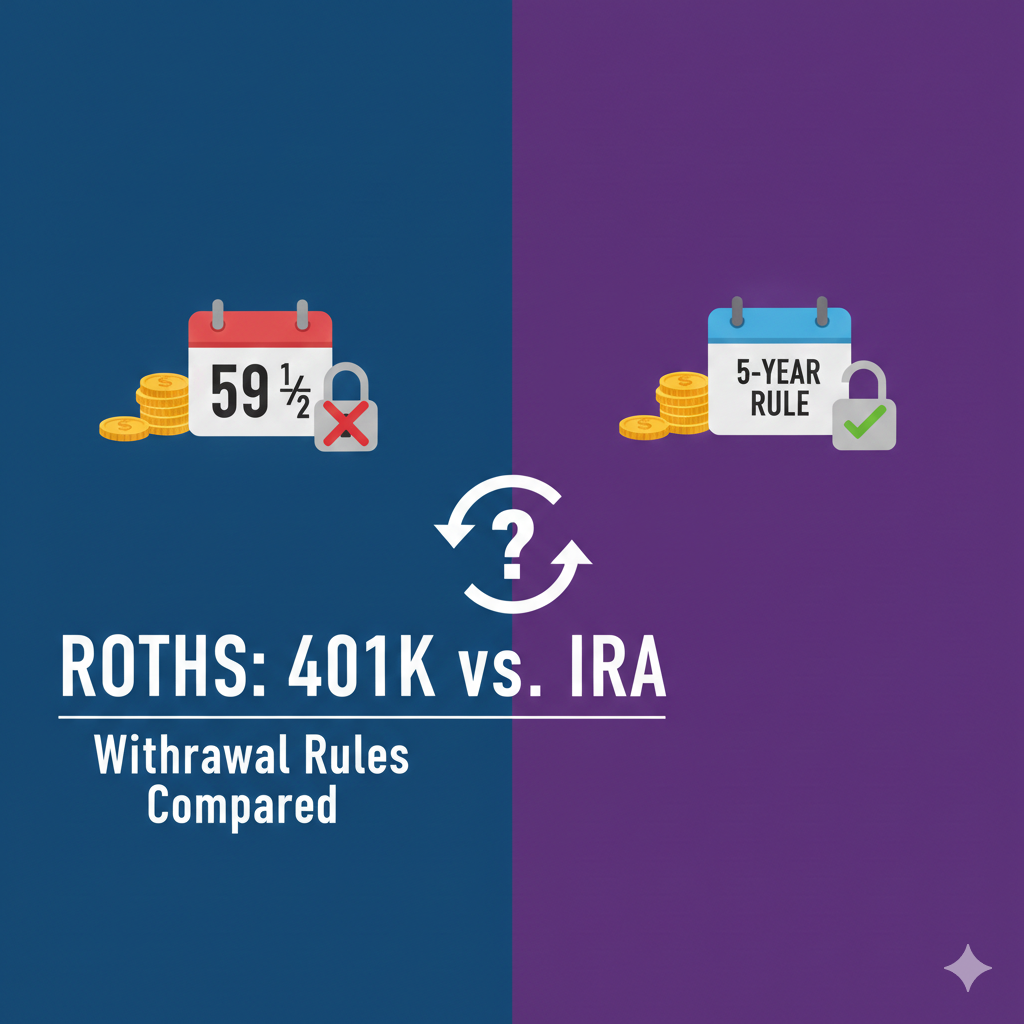
Roth 401(k) vs. Roth IRA: Understanding the Withdrawal Rules That Matter Most
Both the Roth 401(k) and the Roth IRA offer the same core benefit: tax-free growth and tax-free withdrawals in retirement. But when it comes to accessing your money—especially before age 59½—the two accounts play by very different rules. Understanding those differences can make a meaningful impact on your financial flexibility, particularly if you experience a job change, need to tap into your savings earlier than planned, or are looking to build savings for an early retirement.
Roth 401(k) Withdrawal Rules
The Roth 401(k) is an employer-sponsored account, and its withdrawal rules reflect that structure. To take a completely tax-free and penalty-free “qualified distribution,” you must meet two requirements: you must be at least age 59½, and your Roth 401(k) account must have been open for at least five years. If you take a distribution before meeting both of those conditions, things get less favorable.
Here’s the key distinction: when you withdraw from a Roth 401(k) before satisfying those requirements, the distribution is treated on a pro-rata basis. That means each withdrawal is considered to be a proportional mix of your original contributions (which have already been taxed and come out tax- and penalty-free) and your earnings (which are subject to income tax and a potential 10% early withdrawal penalty). You cannot choose to withdraw just your contributions first. The IRS requires that every dollar you pull out reflects the ratio of contributions to earnings in the account.
Roth IRA Withdrawal Rules: Greater Flexibility
The Roth IRA follows a much more favorable set of withdrawal ordering rules, and this is where the real advantage lies. The IRS uses a specific hierarchy for Roth IRA distributions, and it works in your favor:
Your direct contributions come out first—always. Because you’ve already paid taxes on those contributions, you can withdraw up to your total cost basis (the amount you’ve contributed over the years) at any time, for any reason, at any age, completely tax-free and penalty-free. There is no pro-rata calculation, no age requirement, and no five-year waiting period for accessing your own contributions.
Only after you’ve withdrawn all of your contributions does the IRS consider you to be dipping into conversion amounts (which have their own five-year rules) and then finally into earnings. Earnings withdrawn before age 59½ and before the account has been open for five years may be subject to taxes and the 10% penalty—but the point is that you have to work through your entire contribution base before that ever becomes an issue.
This ordering rule gives the Roth IRA a unique dual purpose: it’s a retirement savings vehicle and a financial safety net. Knowing that your contributions are always accessible without penalty provides tremendous peace of mind.
The Rollover Advantage: Moving Your Roth 401(k) to a Roth IRA
This difference in withdrawal rules is exactly why it’s worth considering a rollover when you leave an employer. If you separate from service—whether through a job change, retirement, or any other departure—you have the option to roll your Roth 401(k) balance into a Roth IRA.
By doing so, you unlock the more favorable Roth IRA withdrawal ordering rules. Once the money is in a Roth IRA, your contributions are accessible first—without the pro-rata treatment that would apply inside the 401(k). This gives you significantly more flexibility if you ever need to access funds before age 59½.
One important note: when you roll a Roth 401(k) into a Roth IRA, the rollover amount is treated as a conversion for purposes of the five-year rule on converted amounts. However, if you already have an existing Roth IRA that has been open for at least five years, the overall account satisfies the five-year requirement—so there’s a potential benefit to opening a Roth IRA early, even with a small contribution, to start that clock ticking.
The Bottom Line
Both the Roth 401(k) and Roth IRA are excellent vehicles for building tax-free retirement income. But when it comes to withdrawal flexibility—especially before 59½—the Roth IRA has a clear edge. The ability to access your contributions penalty-free at any time, without the pro-rata rules that govern the Roth 401(k), makes the Roth IRA a more versatile account. And if you’re leaving an employer, rolling your Roth 401(k) into a Roth IRA is one of the simplest ways to gain that added flexibility.
Have questions about whether a rollover makes sense for your situation? Reach out to Forty W Advisors—we’re here to help you make the most of your retirement savings.
This article is for informational purposes only and should not be considered tax or investment advice. Individual circumstances vary. Please consult with your financial advisor and tax professional before making any decisions regarding account rollovers or distributions.